
Legalization Without Guarantees Is Not Reform
Penal code reform left the drug war's machinery in working order. In a new law review article, Amber Baylor argues that dismantling it requires structural guarantees.


Racial disparities in cannabis arrests got worse in Massachusetts after legalization. Mothers in states where cannabis is legal are losing custody of their children over use. Tax revenue from legal sales flows back to the same police departments that waged the drug war. Legalization, as actually practiced, is not doing what it said it would.
A new article in the Washington and Lee Law Review explains why. In “Drug War Repair Guarantees,” published this spring, Columbia Law professor Amber Baylor argues that legalization limited to penal code changes is illusory. Legalization, at minimum, is supposed to mean that using the substance no longer gets you punished by the state.
But on the ground, what impacted communities experience is what Baylor calls “an interconnected regime of civil consequences, violent law enforcement, and resource deprivation.” Family courts treat legal cannabis use as grounds for removing children. Housing laws permit eviction for possession. Welfare bans stripped benefits from women convicted of drug offenses, 85% of whom had no idea the ban existed. Penal code reform doesn’t touch most of this and what it doesn’t touch, it leaves in working order.
Reform without institutional change is, as Baylor describes it through transitional justice scholarship, “tension-easing, advanced to smooth relations, but leaving untouched the institutional source of injuries.” Palliative. Baylor warns that reforms leaving those systems intact can be reconstituted the moment political winds shift. We are watching that happen now, as courts dismantle equity programs, recriminalization returns through fentanyl panic, and federal enforcement postures escalate.
Baylor’s most practical contribution is a framework borrowed from international law: “guarantees of non-repetition,” developed in post-conflict settings and applied by the Inter-American Court in cases arising from drug enforcement operations. The framework insists that policymakers address what is experienced by impacted people, rather than what legislators assume the drug war was.
The process starts with collaborative inquiry, where affected communities map the local drug war as they lived it. Then legislative reform reaching into family, housing, employment, and policing law. Then ongoing monitoring by community-led institutions with real decision-making power. Cannabis control boards in over twenty legal states could be expanded to serve this function.
This work is already happening. Equity and Transformation in Chicago organizes around non-repetition demands. Advocates in multiple cities have tied guarantee proposals to legalization efforts: ending family separation over cannabis use, prohibiting pretextual police stops justified by cannabis odor, redirecting tax revenue from police budgets toward community health.
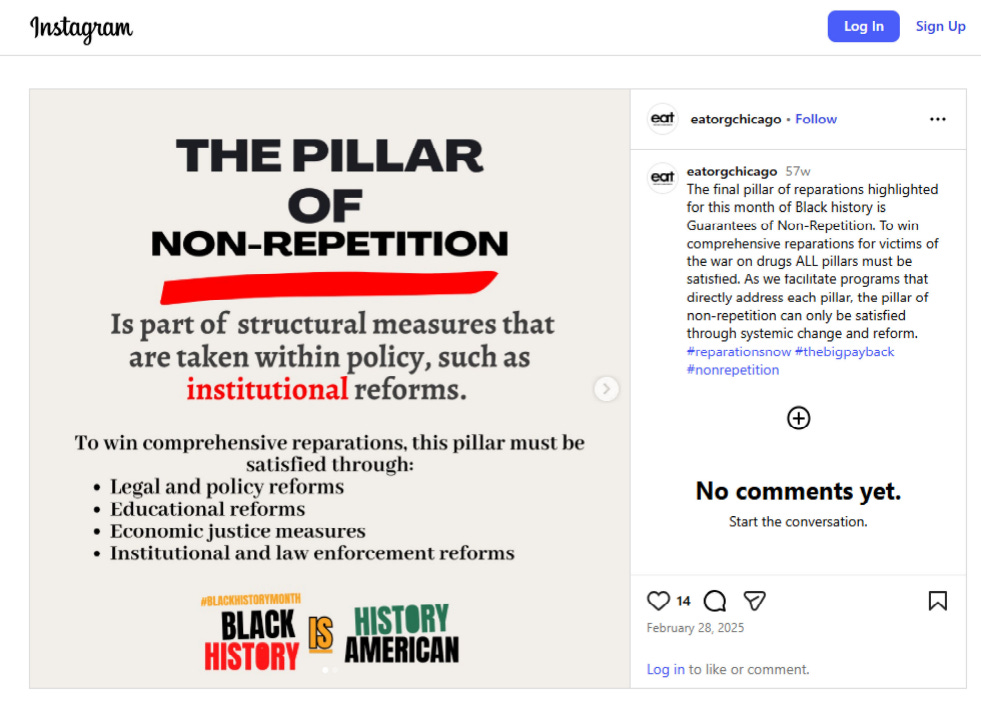
Image: Equity and Transformation (@eatorgchicago), “The Pillar of Non-Repetition,” February 2025.
Baylor’s argument operates in the criminal justice and civil rights lane. But the logic runs parallel to what Parabola has argued about anti-consolidation protections. When legalization produces a market dominated by well-capitalized outsiders while the communities it claimed to repair remain under surveillance, subject to civil penalties, and shut out of economic participation, the reparative promise is hollow. Baylor grounds that argument where the stakes are custody of your children, the right to keep your housing, and whether the police unit that surveilled your neighborhood for thirty years still has the funding and the weapons to keep doing it.
Amber Baylor, Drug War Repair Guarantees, 83 Wash. & Lee L. Rev. 33 (2026).
Available at scholarlycommons.law.wlu.edu.
 | A guest post by
|